
These sourdough oatmeal cookies have crisp edges, soft centers and a rich, nutty flavor from browned butter. Best of all, they use a full 1 cup (240g) of sourdough discard, making them a delicious way to use up the extra starter in your refrigerator.
Customize them with raisins, chocolate chips, nuts or your favorite mix-ins. The dough can also be made ahead and refrigerated or frozen, so you can bake a fresh batch whenever a cookie craving hits.

Jump to:
Why You Will Love This Recipe
- Uses a full cup of sourdough discard. This recipe uses 1 cup (240g), so it's a great option when you have a lot of discard to use.
- Rich browned butter flavor. Browning the butter gives these oatmeal cookies a deeper, nutty flavor.
- Crisp edges and soft centers. The cookies bake up lightly crisp around the edges while staying soft and chewy in the middle.
- Easy to customize. Add chocolate chips, raisins, nuts or a combination of your favorite mix-ins.
- Freezer-friendly. Freeze the portioned cookie dough so you can bake fresh oatmeal cookies whenever you want them.
Recipe Ingredients
You will need the following ingredients to make these soft and chewy Sourdough Oatmeal Cookies.

Butter: Browning the butter gives the cookies a rich, nutty flavor. Allow it to cool slightly before mixing it with the other ingredients.
Brown Sugar and White Sugar: The combination of brown sugar and white sugar helps create the cookies' chewy centers and crisp edges. Brown sugar adds moisture while white sugar helps the cookies spread as they bake.
Bread Flour: I typically use bread flour rather than all-purpose flour in my cookie recipes. Bread flour helps to create a chewier cookie. For accuracy, the best way to measure the flour is by using a digital kitchen scale.
Tip: If you don't have a digital scale, spoon the flour into the measuring cup and level it with the back of a butter knife. Try not to compress the flour into the measuring cup. Too much flour creates dense cookies.
Old-Fashioned Rolled Oats: Don't use quick oats or steel-cut oats. The texture won't be correct and they absorb different amounts of liquid so your cookies may end up dry.
Salt: I add at least a pinch of salt to all of my recipes. Salt complements and intensifies the other flavors. For all of my recipes, I use Morton Kosher Salt which packs more densely than Diamond Crystal Kosher Salt. If you are using Diamond Crystal Kosher Salt you will want to double the amount of salt you add.
Egg Yolks: Egg yolks add fat and richness to the cookies. They also add less moisture than whole eggs, helping balance the additional moisture from the sourdough discard.
Tip: Egg whites and egg yolks are easier to separate while they are still cold. Separate the eggs, save the whites for another recipe, and then allow the yolks to come to room temperature.
Sourdough Discard: This recipe uses 1 cup (240g) of sourdough discard. There's no need to feed your discard first. Older discard will generally give the cookies a stronger sourdough flavor than newer discard.
How much sourdough discard do you have? This recipe uses 1 cup (240g). If you have a different amount to use, visit What Can I Make With My Sourdough Discard? to find a recipe based on how much discard you have.
See the recipe card for full information on ingredients and quantities.
Substitutions and Variations
- Salted Butter: If you only have salted butter, omit the additional salt in the recipe. One stick of salted butter contains approximately ¼ teaspoon of salt.
- Add More Spice: Cinnamon and oats are a classic combination. For a warmer, spicier cookie, add ¼ teaspoon each of nutmeg and ginger.
- Add Your Favorite Mix-Ins: Add up to 1½ cups of your favorite mix-ins, or use a combination. A few ideas include:
- Chocolate Chips: Try semisweet, dark chocolate, butterscotch, peanut butter or caramel chips.
- Nuts: Try walnuts, pecans, cashews, pistachios or your favorite nuts.
- Dried Fruit: Raisins are the classic choice for oatmeal cookies, but dried cranberries, coconut, chopped dried apples or other dried fruit also work well.
- Candy: Chopped candy bars or M&M's can turn the base oatmeal cookie into something completely different.
Step by Step Directions
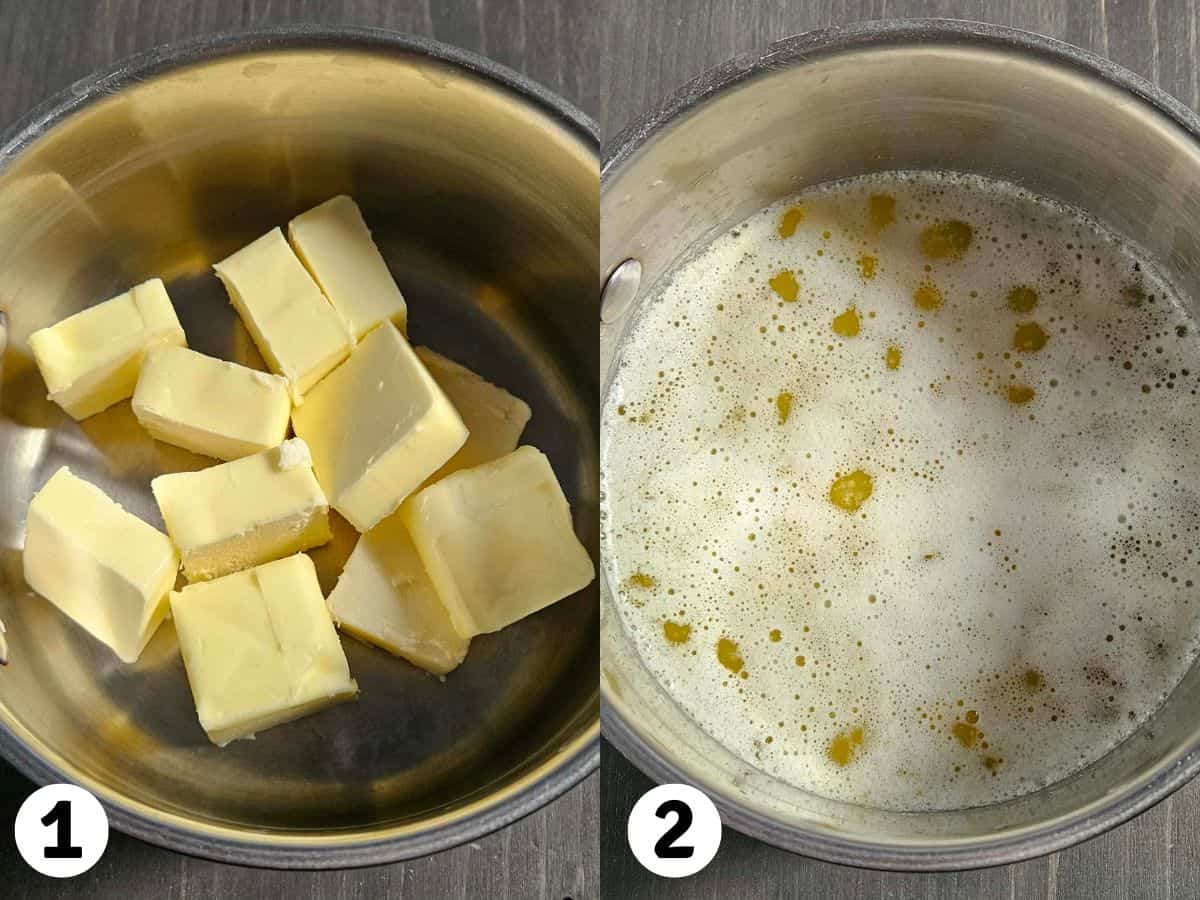
Step 1: Slice the butter into pieces and melt it in a light-colored skillet over medium heat stirring or whisking constantly. (Image 1) Once melted, the butter will begin to foam. (Image 2)
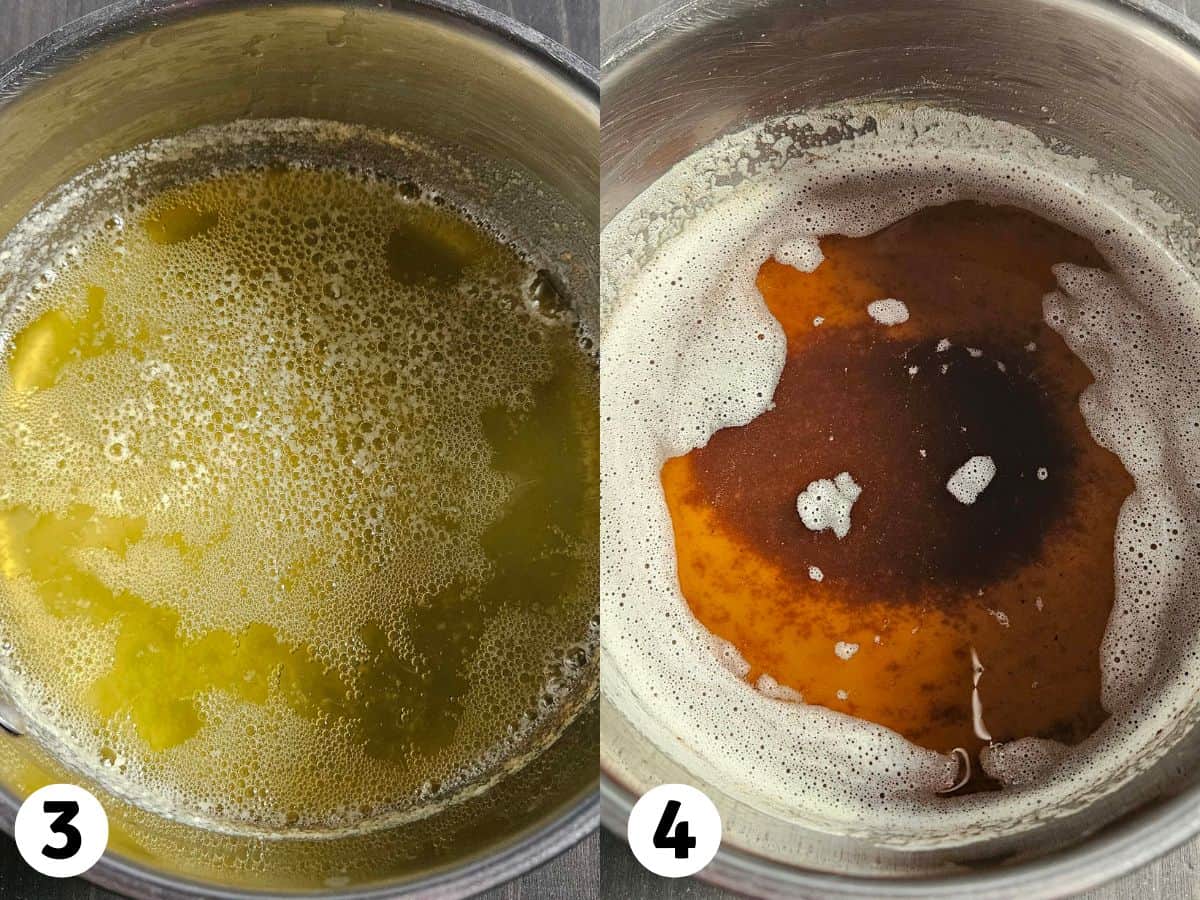
Continue stirring/whisking for about 5-7 minutes. The foam will begin to subside and the milk solids will darken to a deep amber color. (Images 3 & 4) Remove the browned butter from the heat, and pour it into a bowl. Allow it to cool for 30 minutes.
Tip: Use a light-colored pan to make it easier to monitor the color of the butter as it browns.
If you still have questions about how to brown butter, check out this video on how to brown butter from America's Test Kitchen.

Step 2: In a large bowl, whisk together the browned butter, brown sugar and sugar until there are no lumps of brown sugar. (Image 5)
Add the egg yolks and vanilla and whisk until smooth. (Image 6) Fold in the sourdough discard. (Image 7)

Step 3: Stir in the baking soda, salt, and cinnamon. Add the oats and bread flour and stir until just combined.
Gently fold in any desired mix-ins. (Image 8)
Wrap the dough in wax paper and refrigerate for 2-3 hours. (Image 9)
Tip: Chilling allows the butter in the dough to firm up and gives the flour time to fully hydrate, which helps prevent the cookies from spreading too much.

Step 4: Preheat the oven to 350°F (180°C). Remove the dough from the refrigerator and roll it into balls, about 2 tablespoons of dough each. If the dough is crumbly at first, continue working it with your hands until it becomes smoother and easier to roll. (Image 10)
Place the dough balls on an ungreased cookie sheet leaving at least 2 inches in between each cookie. (Image 11)
Tip: Use a light-colored cookie sheet. Dark cookie sheets absorb more heat and can cause the bottoms of the cookies to overbake.

Step 5: Bake for 12-15 minutes, or until the edges are lightly browned but the centers are still soft. (Image 12) Allow the cookies to cool on the baking sheet for at least 5 minutes before transferring them to a wire rack to cool completely. (Image 13)
Tip: For crispier cookies: Increase the baking time by 2-3 minutes.
Tip: Want perfectly round cookies? Immediately after removing the cookies from the oven, place a round cookie or biscuit cutter around each cookie and gently move it in a circular motion to reshape the edges.
Don't forget to sample at least one deliciously gooey straight-from-the-oven cookie for "quality control" of course.
Make-Ahead, Storage, and Freezing Instructions
Make-Ahead: Prepare the cookie dough and refrigerate it for up to 3 days. Chilling the dough helps prevent the cookies from spreading too much by hydrating the flour and allowing the butter to firm up.
Storing Baked Cookies: Store cooled cookies in an airtight container at room temperature for up to 4 days.
Freezing Cookie Dough: Unbaked cookie dough balls can be frozen for up to 3 months. Place the portioned dough balls on a parchment-lined baking sheet and freeze until solid. Transfer them to a freezer-safe bag or container and label with the date.
When you're ready to bake, transfer the frozen dough balls to the refrigerator and allow them to thaw overnight. Bake according to the recipe instructions.
Freezing Baked Cookies: Allow the cookies to cool completely, then freeze them in an airtight container or freezer-safe bag for up to 3 months.
Thaw frozen cookies overnight in the refrigerator or on the counter.
Recipe FAQs
Old-fashioned rolled oats work best for these cookies. They provide a chewy texture without becoming too soft like quick oats or as firm as steel-cut oats.
Yes. You can use either active sourdough starter or sourdough discard. Active starter may give the cookies a slightly tangier flavor, while newer discard will generally have a milder flavor.
Overbaking or adding too much flour can make the cookies hard or dry. For the most accurate flour measurement, use a kitchen scale. The cookies should still be soft in the center when you remove them from the oven and will continue to set as they cool.
Too much flour can prevent the cookies from spreading properly. For the most accurate measurement, weigh the flour with a kitchen scale. If measuring by volume, spoon the flour into the measuring cup and level it off rather than scooping directly from the bag.
Comment below and tell me when it comes to oatmeal cookies, are you team chocolate chip or team raisin?
📖 Recipe
Sourdough Oatmeal Cookies
These sourdough oatmeal cookies have crisp edges, soft centers and a rich, nutty flavor from browned butter. They use a full cup of sourdough discard and can be customized with your favorite mix-ins.
Ingredients
- 1 cup unsalted butter
- 1 cup brown sugar
- 1 /4 cup granulated white sugar
- 4 egg yolks
- 2 teaspoons vanilla extract
- 1 cup sourdough discard
- 1 teaspoon baking soda
- 1 teaspoon Morton kosher salt or 2 teaspoons Diamond Crystal kosher salt
- 1 teaspoon ground cinnamon
- 3 cups rolled old fashioned oats
- 2 cups bread flour
- 1 ½ cups of your favorite mix-ins
Instructions
- Slice the 1 cup unsalted butter into pieces and melt it in a light-colored skillet over medium heat whisking constantly. Once melted, the butter will begin to foam.
- Continue stirring/whisking for about 5-7 minutes, the butter will become a deep amber color. Remove the browned butter from the heat, and pour it into a bowl. Allow the butter to cool for 30 minutes.
- In a large bowl add the browned butter, 1 cup brown sugar, and 1 /4 cup granulated white sugar. Whisk until there are no lumps of brown sugar.
- Add the 4 egg yolks and 2 teaspoons vanilla extract. Whisk together until smooth. Fold in the 1 cup sourdough discard.
- Stir in the 1 teaspoon baking soda, 1 teaspoon Morton kosher salt, and 1 teaspoon ground cinnamon. Add the 3 cups rolled old fashioned oats and 2 cups bread flour and stir until just combined.
- Gently fold in 1 ½ cups of your favorite mix-ins. See the list above for some ideas.
- Wrap the dough in wax paper and refrigerate for at least 2-3 hours.
- Preheat the oven to 350°F (180°C). Remove the dough from the refrigerator and roll it into balls, about 2 tablespoons of dough each. The dough may be a bit crumbly but will become smoother as you roll it.
- Place the dough balls on an ungreased cookie sheet leaving at least 2 inches in between each cookie. Flatten the balls slightly with your hand to help them spread.
- Bake for 12 - 15 minutes or until the edges are lightly browned but the center is still soft. Allow the cookies to cool for at least 5 minutes before transferring them to a wire rack to cool completely.


A says
So nice to find a great recipe that uses a substantial amount of starter discard, AND tastes great. My family really enjoyed these cookies. I baked them a full 15 minutes. Note, when I printed the recipe in February '23, it had weights for the ingredients, which I used, and they worked fine... After baking the cookies, I noticed weights were no longer listed and there were some comments where people had issues/questions with the weights, but the version I printed back in February worked perfectly.
Erica Schramek says
I am so happy you enjoyed the cookies. When I make sourdough discard recipes I always want to use up at least a cup of sourdough so most of my discard recipes are written that way. A couple months ago I had to switch recipe card plugins which is what generates the recipe at the bottom of blog posts. The metric measurements are still there. The can be accessed using the toggle next to the ingredients header. You can select either US Customary or Metric.
Tracy says
These were so good! I am a cookie snob and these came out exactly as I like them too. Thanks for sharing the recipe.
Erica says
I am so happy you liked them. My husband and I call ourselves dessert snobs. It has to be really good to be worth the extra calories.
Carly says
Do you think I could substitute my fairly runny peanut butter for the butter? Been looking for a peanut butter oat sourdough cookie but haven’t been able to find one. Thanks!
Erica says
I would start by substituting peanut butter for half the butter in the recipe. I wrote a peanut butter chocolate chip cookie recipe and it calls for equal amounts of butter and peanut butter which works well.
Don't worry about heating the peanut butter. The purpose of browning the butter is to reduce the moisture content to account for the extra liquid in the sourdough discard.
You may need also add a bit more flour to reach the proper consistency.
Alex says
I made these according to the recipe but did chill dough over night. The cookies didn’t spread at all so it was hard to get the center cooked before the outside got too browned.
Erica says
There are a couple of possibilities. Do you have an oven thermometer to verify that your oven is heating to the correct temperature? If the oven is too cool the cookie won't spread as much. Are you using a scale to measure your ingredients? Flour in particular can be tough to measure accurately using cups. Too much flour will create a dryer dough that won't spread as much. Another possibility is the sourdough discard. Is it at 100% hydration? If it is dryer then much like adding too much flour that will affect how much the cookies spread.
Leslie says
You nailed it with this photo it stopped the scroll and I had to check it out because I was drooling a little bit not gonna lie. Save this post to give it a try our next get together for my family. Thank you for sharing this recipe.
INGE KOHL says
I am planning on making these with chocolate covered raisins from Trader Joe's - just because I couldn't resist them at the store. My sourdough discard needs to be used as well, so your recipe fills both needs. I wanted to tell you how much I appreciate you taking the time to post measurements in weights. I too use King Arthur's weight conversion chart anytime a recipe doesn't use grams. It's an extra step, but so much more accurate.
Thank you!
Erica says
Yum! Adding chocolate-covered raisins sounds delicious.
Toni says
I was sent 2 canisters of steel cut oats. Can I substitute these steel cut oats for the regular oats??
Erica says
I wouldn't steel-cut oats are much harder than rolled oats and will absorb more moisture throwing off the texture of the cookie and might also remain crunchy.
Stephen Wilson says
Hi Erica, Could you clarify something in your article on eliminating the water from the egg whites and browning the butter? Your article states that you are able to use sourdough starter when you eliminate 184 grams of water by not using the egg whites and browning the butter but your recipe calls for 240 grams of sourdough starter at 100% hydration. 240 grams of starter at that hydration would consist of 120 grams of water. Where does the missing 64 grams of liquid come into play? Is the recipe correct for using 240 grams of starter or should it be 368 grams to give you the 184 grams that your article mentions? I don’t want to mess up the batch of cookies I’m fixing to make from this great recipe. Thanks for any clarification on this.
Erica says
You are right that section is confusing and something isn't correct. It's a great example of why I was an art major in college and not a math major. I am taking that section out of the post until I can figure out my math error. My biggest fear publishing recipes is that someone will struggle with one of them so in a fit of paranoia I mixed up and baked a batch of these cookies this evening. The recipe is sound and works wonderfully.
Shar C says
Hi! I was trying to follow your gram measurements and some of them were really off. Like the flour is 2400g, I knew it was a typo, but if someone is following this recipe using grams, this would be a grave error. I just followed the cup measurement. Also, the brown sugar gram measurement that you listed would yield closer to 2 cups of brown sugar. I weighed out 1 cup and it is closer to 131g. I just wanted to bring these things to your attention, since you had recommended using the gram measurement and using a scale to weigh out the ingredients.
I'm always excited to be able to use my sourdough discard recipe, so, I am looking forward to baking these and tasting them.
Erica says
Thank you for the heads up I've already revised the measurements. Your right the measurement for the flour had an extra 0 at the end. When you weighed the brown sugar, did you pack it into the cup? I ask because I use a conversion chart on the King Arthur Baking website to help me standardize my conversions between volume and weight measurements. 1 cup of brown sugar weighing 213 grams is accurate.
Tina G. says
I made these cookies today and they are amazing! I froze half of the dough balls to enjoy later. Thanks for this great discard recipe!!
Erica says
Yay! I am so happy you liked them.