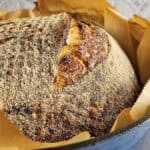
Same Day Sourdough Bread
This same-day sourdough bread recipe is designed to take you from mixing to baking in just a few hours, so you can enjoy a warm, homemade loaf with dinner without waiting overnight.
Servings: 12
Calories: 160kcal
Equipment
- parchment paper
Ingredients
- ½ cup sourdough starter
- 4 cups bread flour
- 1 ½ cup warm water
- 1 ½ teaspoon kosher salt
- rice flour for dusting
Instructions
- Early in the morning, feed your starter with warm water and flour. Cover and let it rest at 80°F and 85°F (27°C and 29°C) until bubbly and doubled in size. This should take around 4 hours. (Skip this step if your starter is already active and ready to bake with.)
- About 1 hour before your starter is ready to use, mix the flour and water in a bowl. I find a dough whisk helpful for this step. Cover and let rest for 1 hour.
- Add the sourdough starter and salt to the flour and water mixture. Mix with the dough whisk or by using a pinching motion with your hand. Cover and let it rest at 80°F and 85°F (27°C and 29°C) for 20 minutes.
- Perform stretch and folds every 30 minutes for the first two hours. Cover the dough in between stretch and folds. You will complete four sets of stretch and folds.
- Cover and let it rest at 80°F and 85°F (27°C and 29°C) for 1 to 2 hours.
- Turn the dough out onto a lightly floured surface. Fold the sides of the dough onto itself, pressing down gently to seal as you fold each side. Turn the dough over so that it is seam side down. Cover with a towel and rest the dough for 15 to 10 minutes.
- Flour the banneton evenly with rice flour and set it aside.
- Lightly flour your work surface. Flip the dough over so that the seam side is up. Grab opposing points of the dough and fold them towards the center. Continue working your way around the dough, folding opposing points of the dough towards the center until the dough is bundled into a round.Clear most of the flour from the work surface and flip the dough over so that the seam side is down. Use your hands or a bench scraper to gently pull the dough towards you, tucking the dough under itself. Give the dough a quarter turn and pull the dough towards you again. Repeat this process two more times. This helps create surface tension across the top of the dough.
- Place the shaped dough in the banneton, seam side up.Cover the dough with plastic and let it rest at 80°F - 85°F (27°C and 29°C) for 1 to 2 hours. Use the poke test to determine if your dough is finished proofing.
- Place a Dutch oven in the oven and preheat to 450°F (245°C) for 30 minutes. Dump the dough out of the banneton and onto a sheet of parchment paper. Score the dough with a bread lame or sharp knife. Carefully, transfer the piece of parchment paper with the dough into the hot Dutch oven.
- Bake covered for 20–25 minutes. Bake uncovered for 20–25 minutes. The bread should sound hollow when you knock on the bottom, have a dark golden brown color, and an internal temperature of 206-208°F (96-97°C).
- Lift the bread out of the Dutch oven and place on a wire cooling rack. Slide the parchment paper out from under the bread. Cool for at least 1 hour before slicing.
If you don’t have extra starter, add an extra 5–10 grams to each portion (starter, flour, and water) so you have enough to bake with and still keep your starter going.
If your starter isn’t ready, wait longer, move the starter to a warmer spot, or feed again and delay your bake.
Use damp hands when performing the stretch and folds. To keep the dough from sticking to your hands.
Bulk fermentation is complete once the dough has risen 30-50%, has a slightly domed surface, and jiggles when the bowl is shaken. If at the end of two hours the dough is not showing these readiness signs, allow the dough to ferment for longer.
Notes
- To speed this recipe up, feed your sourdough starter the night before you want to bake. If you are feeding your starter the night before, I suggest changing the ratio to 1:5:5 ratio (15 grams active sourdough starter, 75 grams flour, 75 grams water).
- Use damp hands when performing the stretch and folds. To keep the dough from sticking to your hands.
- Use a kitchen scale to weigh your ingredients rather than the cup measurements.
- Baking times for all recipes are only suggestions. The actual baking time will vary depending on your oven. It is helpful to know your oven and worth purchasing an inexpensive oven thermometer. Oven temperatures can vary as much as 50 degrees plus or minus.
- If your sourdough bread tends to burn or get really dark on the bottom when baking, place a baking sheet on the rack directly below the Dutch oven while baking your bread. This will help to deflect some of the heat.
- Use a serrated knife when cutting bread for easier cleaner slices.
Nutrition
Serving: 1slice | Calories: 160kcal | Carbohydrates: 32g | Protein: 5g | Fat: 1g | Saturated Fat: 0.1g | Polyunsaturated Fat: 0.3g | Monounsaturated Fat: 0.1g | Sodium: 293mg | Potassium: 42mg | Fiber: 1g | Sugar: 0.1g | Vitamin A: 1IU | Calcium: 7mg | Iron: 0.4mg
