How to Dehydrate and Rehydrate Your Sourdough Starter
Learn how to dehydrate your sourdough starter. A dehydrated starter protects your starter from mold, neglect, and accidents. No matter what happens you will always have a sourdough backup.
Equipment
- parchment paper or silicone baking mat
Ingredients
- sourdough starter recently fed and active
Instructions
Dehydrating Sourdough Starter
- Line a baking sheet with parchment paper or a silicone baking mat. Pour a thin layer of active starter onto the parchment paper and spread it evenly using an offset spatula. The thinner the layer, the faster it will dry.
- Let the starter dry completely at room temperature in a dry, well-ventilated area. This can take anywhere from 12 to 24 hours depending on the humidity.
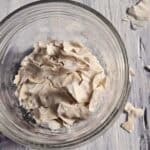
- Once the starter is completely dry, brittle, and easy to break into flakes, break the dried starter into small pieces or grind it into a fine powder using a food processor or blender.
- Store it in an airtight container, glass jar, or vacuum-sealed bag in a cool, dark place. Label it with the date and contents.
Rehydrating Sourdough Starter
- Stir together 15 grams of dried starter and 30 grams of water. The sourdough flakes should be completely submerged. Allow the mixture to sit for 1 hour stirring occasionally until the sourdough flakes have completely dissolved.
- Add 15 grams of flour and 15 grams of water. Stir to combine.Wait until the mixture is nice and bubbly and has doubled in size. The length of time this will take will depend on the temperature of your home.
- Discard all but 20 grams of the starter. Add 20 grams of flour and 20 grams of water. Stir well and let sit at room temperature for twelve hours. It should double in size.
- To strengthen your starter, feed it twice daily, discarding all but 20 grams and feeding it equal amounts of flour and water each time, until it becomes bubbly and active. This usually takes 3-5 days.Once your starter is consistently rising and doubling in volume, it's ready for use.You can then return to your regular storage method and feeding schedule.
Notes
Storage: Keep it in an airtight container, such as a glass jar, vacuum-sealed bag, or zip-top bag, and store it in a cool, dark place.
Tips
- Always use clean utensils to avoid contamination.
- A well-established, active starter with strong fermentation activity will dehydrate and revive more successfully than a weak or unfed starter.
- Give your starter a fresh feeding 12-24 hours before drying to ensure it is at peak activity.
- The thinner you spread the starter on your parchment paper or silicone mat, the faster and more evenly it will dry.
- Ensure the dried starter is completely dry before storing, as any residual moisture can cause mold.
- Keep dehydrated starter in an airtight container, such as a glass jar, vacuum-sealed bag, or zip-top bag, and store it in a cool, dark place.
- Once fully dried, grinding your starter into a fine powder can help it rehydrate more quickly when you’re ready to revive it. Make sure your blender or food processor is completely dry. You do not want to accidentally introduce moisture.
